



Many businesses experience operational inefficiencies without realizing that the root cause often lies in unresolved workforce management issues. Poor workforce coordination, communication gaps, attendance inconsistencies, and lack of workforce visibility gradually affect productivity and business performance over time.
As organizations grow, workforce operations become more complex. Managing employees, attendance, schedules, communication, and workforce reporting manually becomes increasingly difficult. Without structured workforce systems, businesses start facing serious workforce management problems that impact both employees and operations.
These operational gaps create ongoing workforce productivity challenges, reduce employee engagement, and slow down business efficiency. In many organizations, poor workforce management also leads to confusion in responsibilities, delayed reporting, and inefficient workforce planning.
In this blog, we will explore the 7 signs of poor workforce management in your organization, understand how these operational issues affect productivity, and see how smarter workforce systems like Tempus Central’s Tempus People can help businesses improve workforce visibility, employee coordination, and operational efficiency.
Why Workforce Management Matters in Modern Organizations
Effective workforce management helps businesses:
- Improve operational visibility
- Enhance employee productivity
- Reduce workforce inefficiencies
- Improve attendance management
- Strengthen workforce coordination
Organizations that fail to manage workforce operations properly often experience ongoing workforce management issues that affect productivity and business growth.
Modern workforce operations require structured systems and centralized workforce visibility to maintain operational efficiency.
1. Workforce Management Issues Create Frequent Communication Gaps
One of the biggest signs of poor workforce management is inconsistent communication between managers, HR teams, and employees.
Poor communication often results in:
- Delayed task completion
- Operational confusion
- Reduced accountability
- Workflow disruptions
These workforce management issues reduce operational efficiency and create unnecessary delays across teams.
Communication breakdown is one of the most common workplace challenges organizations face during operational expansion.
Without centralized communication and workforce visibility, businesses struggle to maintain operational coordination effectively.
2. Workforce Management Issues Cause Attendance and Scheduling Problems
Attendance inconsistencies and scheduling inefficiencies are strong indicators of poor workforce management.
Businesses often experience:
- Attendance discrepancies
- Shift overlaps
- Last-minute schedule changes
- Unbalanced workload allocation
These workforce management problems affect employee productivity and create operational confusion.
Without proper workforce visibility and attendance tracking, organizations struggle to manage workforce schedules effectively.
Poor attendance management also contributes to long-term workforce productivity challenges within organizations.
3. Workforce Management Issues Reduce Employee Productivity
A decline in workforce productivity is another major sign of poor workforce management.
Employees often struggle when:
- Operational expectations are unclear
- Workforce coordination is weak
- Workloads are poorly managed
These operational inefficiencies create ongoing challenges at work and negatively impact employee performance.
When businesses fail to address workforce inefficiencies early, productivity losses gradually affect overall operational performance.
Organizations dealing with unresolved workforce management issues often face delays in task completion and reduced workforce accountability.
4. Workforce Management Issues Reduce Workforce Visibility
Lack of workforce visibility creates major operational challenges for organizations.
Without proper workforce monitoring, businesses struggle to:
- Track workforce activities
- Monitor employee performance
- Generate accurate workforce reports
- Identify operational gaps quickly
These workforce management problems become more difficult to manage as organizations grow.
Poor workforce visibility slows operational decision-making and affects overall business efficiency.
Modern businesses require centralized workforce systems to maintain operational transparency and workforce control.
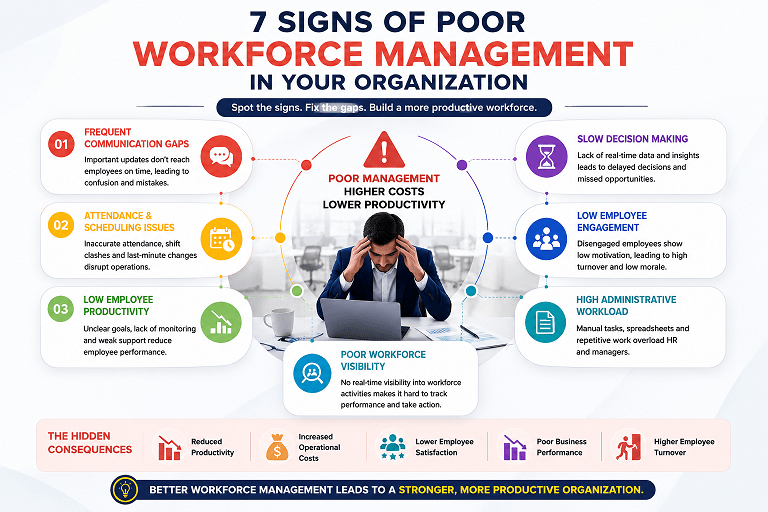
5. Workforce Management Issues Increase Administrative Workload
Organizations relying heavily on spreadsheets and manual workforce tracking often experience higher administrative workload.
Manual workforce processes usually create:
- Reporting delays
- Data inconsistencies
- Attendance tracking errors
- Increased operational dependency on HR teams
These workforce management issues consume valuable operational time and reduce workforce efficiency.
Manual processes also make it harder for organizations to scale workforce operations efficiently.
Reducing manual workforce handling is essential for improving operational productivity.
6. Workforce Management Issues Affect Employee Engagement
Employee engagement is directly connected to workforce efficiency and operational satisfaction.
Employees become disengaged when:
- Workforce coordination is inconsistent
- Attendance processes become confusing
- Communication remains unclear
- Operational support becomes weak
These operational gaps create ongoing workplace challenges that affect employee morale and workplace culture.
Organizations facing continuous workforce productivity challenges often struggle to maintain employee engagement levels.
Improving workforce visibility and workforce coordination significantly helps improve employee satisfaction and productivity.
7. Workforce Management Issues Slow Operational Decision Making
Delayed operational decisions are another major sign of poor workforce management.
Without centralized workforce visibility:
- Managers rely on outdated reports
- Workforce planning becomes inefficient
- Operational responses slow down
These workforce management issues negatively affect operational agility and workforce coordination.
Businesses need real-time workforce visibility to improve workforce planning and operational responsiveness.
Organizations using disconnected workforce systems often struggle to make faster workforce decisions.
How Poor Workforce Management Impacts Organizations
Poor workforce management affects both employees and overall business operations.
Common operational impacts include:
- Reduced workforce productivity
- Increased operational delays
- Lower employee engagement
- Poor workforce coordination
- Higher administrative workload
- Reduced operational efficiency
Over time, unresolved workforce management problems create serious operational inefficiencies that impact long-term business growth.
How Businesses Can Improve Workforce Management
Improve Workforce Visibility
Businesses should focus on improving workforce transparency and operational visibility.
Better workforce visibility helps:
- Improve workforce coordination
- Monitor operational activities faster
- Reduce operational delays
- Improve workforce accountability
Improved visibility helps organizations reduce ongoing workforce management issues.
Reduce Manual Workforce Processes
Replacing spreadsheets and disconnected systems with centralized workforce platforms helps organizations:
- Improve attendance visibility
- Simplify workforce reporting
- Reduce operational delays
- Improve workforce coordination
Reducing manual dependency significantly improves operational efficiency.
Strengthen Workforce Communication
Clear workforce communication improves:
- Team coordination
- Operational alignment
- Workforce accountability
- Employee engagement
Organizations with strong communication processes generally experience fewer workplace challenges.
Centralize Workforce Operations
Centralized workforce management helps organizations:
- Access workforce information in one place
- Improve workforce reporting
- Improve attendance visibility
- Strengthen workforce planning
Centralized systems improve overall workforce operational efficiency significantly.
How Tempus People Helps Solve Workforce Management Issues
As workforce operations become more complex, businesses need smarter workforce systems to improve visibility and workforce coordination.
Tempus Central’s Tempus People helps organizations reduce ongoing workforce management issues by centralizing workforce operations and improving workforce visibility.
With Tempus People, businesses can:
- Improve attendance visibility
- Simplify workforce reporting
- Centralize employee records
- Improve workforce coordination
- Reduce manual workforce dependency
- Strengthen workforce communication
As a modern cloud based HR management software, Tempus People helps organizations streamline workforce processes while improving operational transparency and workforce efficiency.
Businesses dealing with ongoing workforce productivity challenges can use Tempus People to improve workforce visibility and operational decision-making across departments and teams.
Organizations looking for a more structured workforce approach often benefit from using centralized HR and workforce systems that simplify workforce operations while improving employee management efficiency.
Building a More Productive Workforce Environment
Improving workforce management requires organizations to:
- Improve operational visibility
- Standardize workforce processes
- Reduce workforce inefficiencies
- Improve workforce communication
- Centralize workforce operations
Organizations that invest in better workforce systems generally experience improved operational efficiency, stronger workforce coordination, and better employee productivity.
Conclusion
Poor workforce management creates operational inefficiencies that gradually affect productivity, workforce coordination, employee engagement, and business performance. Many organizations continue facing serious workforce management issues without identifying the operational gaps affecting workforce efficiency.
From communication breakdowns and attendance inconsistencies to poor workforce visibility and delayed operational decisions, these operational challenges negatively impact both employees and business growth.
Understanding the 7 signs of poor workforce management in your organization is the first step toward improving workforce productivity and operational efficiency.
Modern workforce systems like Tempus Central’s Tempus People help businesses simplify workforce operations, improve workforce visibility, and reduce workforce management problems through centralized workforce management capabilities.
If your organization is facing ongoing workforce coordination and productivity challenges, it may be the right time to upgrade workforce operations with a smarter HR approach. You can book a demo with Tempus Central to understand about Tempus People feature and how centralized workforce visibility and smarter workforce management can improve operational efficiency across your organization.