




Managing a workforce efficiently has become one of the biggest priorities for modern businesses. As organizations grow, handling employees, attendance, schedules, productivity, and workforce coordination becomes increasingly complex. When these areas are not managed properly, businesses begin facing serious workforce management issues that directly affect productivity and operational performance.
Many companies underestimate how much poor workforce management impacts day-to-day operations. Delayed task completion, communication gaps, low employee engagement, attendance inconsistencies, and inefficient planning slowly reduce overall efficiency. Over time, these problems lead to productivity losses, higher operational costs, and employee dissatisfaction.
Strong workforce management is not just about assigning work. It involves planning, monitoring, tracking, communication, attendance management, and performance visibility. Without structured systems, businesses often struggle to maintain consistent workforce management productivity across departments and teams.
In this blog, we will understand the major causes of workforce management problems, their impact on productivity, and how businesses can improve workforce efficiency using advanced workforce management strategies and systems.
What is Workforce Management?
Workforce management refers to the process of optimizing employee productivity, scheduling, attendance, resource allocation, and workforce operations.
It includes:
- Employee attendance tracking
- Workforce scheduling
- Productivity monitoring
- Shift management
- Workforce planning
- Performance visibility
An effective workforce management process helps organizations improve operational efficiency and maintain better employee productivity management.
Why Workforce Management Matters for Productivity
Productivity depends heavily on how well employees and operations are managed.
When businesses fail to manage workforce activities properly, they face:
- Reduced employee efficiency
- Communication gaps
- Delayed operations
- Increased manual work
- Lower accountability
These workforce management issues negatively impact business performance and operational growth.
Proper workforce management helps:
- Improve employee coordination
- Increase productivity
- Reduce operational delays
- Improve workforce visibility
- Enhance decision-making
Common Workforce Management Issues That Affect Productivity
1. Poor Workforce Planning
One of the biggest workforce management issues that businesses face is ineffective workforce planning.
Without proper planning:
- Teams become overworked or underutilized
- Resources are allocated incorrectly
- Productivity levels become inconsistent
Poor workforce planning often leads to operational inefficiencies and project delays.
Businesses that fail to forecast workforce requirements struggle to maintain stable workforce management productivity.
2. Lack of Workforce Visibility
Many organizations do not have clear visibility into workforce activities.
This creates:
- Difficulty monitoring employee performance
- Delays in identifying productivity gaps
- Poor operational transparency
Limited workforce visibility makes it harder for managers to track productivity and address performance issues quickly.
This is one of the most common workforce management issues affecting growing organizations.
3. Inefficient Attendance Management
Attendance management plays a major role in productivity.
Manual attendance systems often create:
- Attendance inaccuracies
- Delayed reporting
- Proxy attendance issues
- Payroll mismatches
These problems reduce operational efficiency and affect overall employee productivity management.
When attendance data is unreliable, workforce planning and productivity analysis also become inaccurate.
4. Poor Communication Across Teams
Communication gaps can significantly reduce productivity.
Without proper coordination:
- Tasks are delayed
- Employees face confusion
- Teams work inefficiently
Poor communication is one of the hidden workforce management issues that quietly affect business operations.
Strong workforce communication improves collaboration and helps maintain smoother operations.
5. Dependency on Manual Processes
Many businesses still depend heavily on spreadsheets and manual workforce tracking.
This leads to:
- Human errors
- Data duplication
- Delayed updates
- Increased administrative workload
Manual processes reduce workforce management productivity because managers spend more time handling operations instead of improving performance.
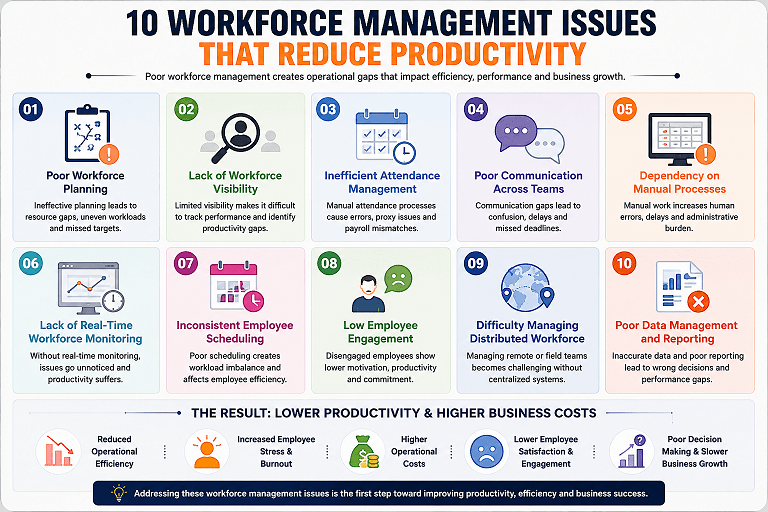
6. Lack of Real-Time Workforce Monitoring
Businesses that lack real-time workforce monitoring often struggle to identify problems quickly.
Without real-time visibility:
- Productivity issues go unnoticed
- Delays increase
- Employee accountability decreases
Real-time monitoring helps organizations identify performance gaps and improve workforce efficiency faster and also helps to reduce workforce management issues.
7. Inconsistent Employee Scheduling
Improper scheduling directly affects employee productivity.
Common scheduling problems include:
- Overlapping shifts
- Unbalanced workloads
- Last-minute scheduling changes
These scheduling inefficiencies create unnecessary pressure on employees and reduce productivity levels.
Scheduling problems are among the most common workforce management issues in businesses with large teams.
8. Low Employee Engagement
Employee engagement has a direct connection with productivity.
Employees who feel disconnected or unsupported often show:
- Reduced motivation
- Lower efficiency
- Increased absenteeism
Poor engagement becomes a major obstacle in maintaining strong employee productivity management.
Organizations with engaged employees generally experience higher operational efficiency.
9. Difficulty Managing Distributed Workforce
Managing employees across multiple locations creates additional challenges.
Businesses often face:
- Lack of centralized monitoring
- Coordination delays
- Communication issues
These distributed workforce challenges can negatively affect workforce management productivity if not handled properly.
10. Poor Data Management and Reporting
Workforce-related decisions depend heavily on accurate data.
Without proper workforce reporting:
- Managers lack operational insights
- Productivity trends become difficult to track
- Decision-making slows down
Poor reporting creates serious workforce management problems for growing organizations.
What is the Impact of Poor Workforce Management on Business Productivity?
Reduced Operational Efficiency
Inefficient workforce management slows down operations and increases process delays.
Businesses often experience:
- Lower task completion rates
- Increased downtime
- Reduced workforce efficiency
These issues directly impact productivity and profitability.
Increased Employee Burnout
Poor workforce management often creates workload imbalance.
This leads to:
- Employee stress
- Fatigue
- Lower productivity
Burnout affects employee performance and increases turnover rates.
Higher Operational Costs
Businesses facing workforce management issues usually spend more on:
- Administrative tasks
- Overtime costs
- Error correction
- Workforce inefficiencies
Poor workforce coordination gradually increases operational expenses.
Reduced Employee Satisfaction
Employees expect:
- Clear communication
- Fair scheduling
- Organized operations
When workforce management is weak, employee dissatisfaction increases significantly.
This negatively affects workplace culture and overall employee productivity management.
Poor Business Decision-Making
Without accurate workforce data, businesses struggle to make informed decisions.
Managers face:
- Delayed reporting
- Incomplete productivity insights
- Poor operational visibility
This affects strategic planning and business growth.
How to Improve Workforce Productivity
Implement Workforce Automation
Automation reduces manual workload and improves efficiency.
Businesses can:
- Automate attendance tracking
- Streamline scheduling
- Improve workforce reporting
Automation helps reduce common workforce management problems significantly.
Improve Workforce Visibility
Real-time workforce visibility allows managers to:
- Monitor employee performance
- Identify productivity gaps
- Improve operational control
Better visibility leads to stronger workforce management productivity.
Use Centralized Workforce Systems
Centralized systems help businesses:
- Manage workforce data in one place
- Improve coordination
- Reduce operational confusion
This improves productivity and decision-making.
Strengthen Employee Communication
Clear communication improves:
- Team collaboration
- Task clarity
- Employee accountability
Strong communication systems reduce productivity delays.
Optimize Workforce Scheduling
Balanced scheduling improves workforce efficiency.
Organizations should:
- Avoid shift overlaps
- Balance workloads properly
- Plan schedules in advance
Effective scheduling improves overall employee productivity management.
Role of Technology in Workforce Management
Technology has transformed workforce operations significantly.
Modern workforce management systems provide:
- Real-time attendance tracking
- Workforce monitoring
- Automated scheduling
- Performance visibility
- Data-driven reporting
These capabilities help businesses reduce operational inefficiencies and improve productivity.
Organizations using modern systems generally experience better workforce coordination and stronger operational control.
How Tempus Central Helps Improve Workforce Productivity
Managing workforce operations manually becomes increasingly difficult as organizations grow.
Tempus Central helps businesses with it’s employee attendance management system:
- Reduce workforce management issues
- Improve attendance visibility
- Streamline workforce operations
- Enhance employee productivity management
- Improve workforce coordination and reporting
By centralizing workforce operations and automating critical processes, businesses can significantly improve workforce management productivity while reducing operational inefficiencies.
Organizations looking to improve workforce efficiency and operational visibility can benefit from adopting smarter workforce management systems.
Conclusion
Poor workforce management does not only affect employees. It impacts productivity, operational efficiency, profitability, and long-term business growth.
From poor scheduling and communication gaps to manual processes and workforce visibility issues, these challenges quietly reduce business performance over time.
Understanding the major workforce management problems affecting productivity is the first step toward building a more efficient and productive organization.
Businesses that invest in better workforce planning, automation, and workforce visibility are better positioned to improve efficiency and maintain sustainable growth.
Modern systems like Tempus Central help organizations simplify workforce operations, improve productivity, and reduce operational inefficiencies through advanced workforce management practices.
If your organization is facing ongoing workforce productivity challenges, it may be the right time to upgrade your workforce operations. You can book a demo with Tempus Central to see how smarter workforce management can improve productivity and operational control.