




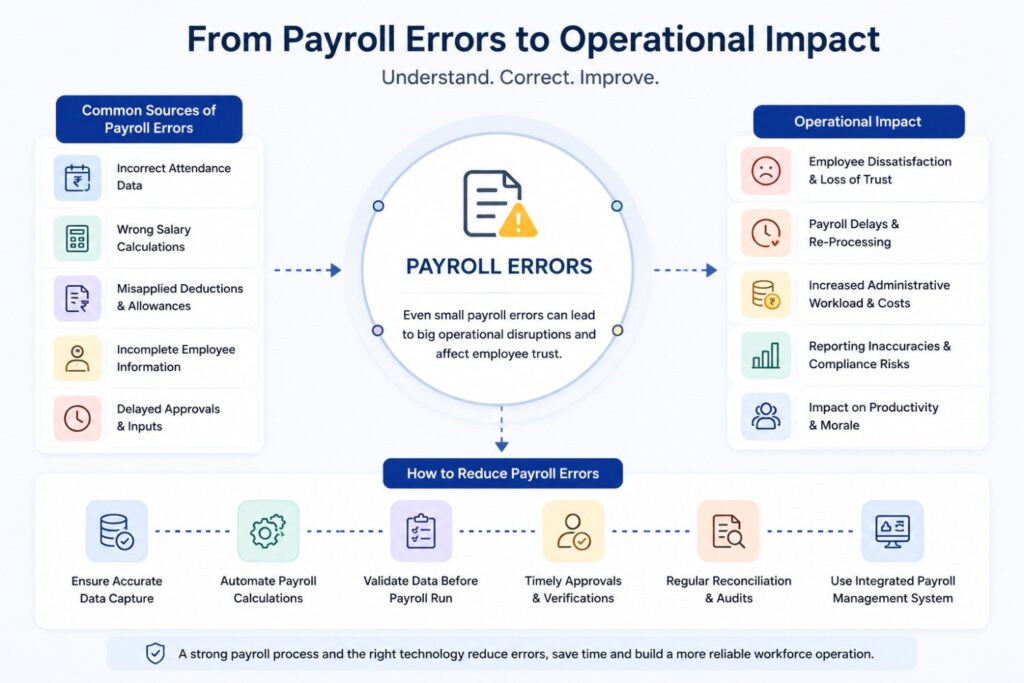
Managing payroll accurately is one of the most important responsibilities for HR and payroll teams. Even small payroll errors can create operational confusion, employee dissatisfaction, payroll delays, and reporting inconsistencies within organizations.
As businesses expand workforce operations across departments and locations, payroll processing becomes more complex. Attendance mismatches, incorrect calculations, approval delays, and reporting inconsistencies often result in frequent payroll corrections that increase administrative workload and operational pressure.
Modern organizations now focus on reducing payroll dependency on manual processes to avoid recurring payroll mistakes and maintain workforce transparency. Businesses also prioritize smarter payroll coordination systems to improve payroll accuracy and employee trust.
In this blog, we will understand the operational impact of payroll errors, common payroll processing challenges, and how organizations can improve payroll services and operations more effectively.
How Payroll Errors Affect Daily Operations
Even minor payroll errors can affect multiple operational activities across businesses.
Payroll inconsistencies often create:
- Salary processing confusion
- Employee dissatisfaction
- Payroll reporting delays
- Workforce coordination issues
- Increased administrative workload
Organizations handling large workforce operations may face higher operational pressure when payroll mistakes are identified at the last moment.
Frequent payroll discrepancies also reduce operational efficiency because HR and payroll teams spend additional time resolving payroll issues instead of focusing on workforce management activities.
Common Payroll Mistakes Businesses Face
Many organizations continue facing several common payroll mistakes because of disconnected workforce data and manual payroll coordination.
Some common payroll problems include:
- Incorrect attendance calculations
- Overtime mismatches
- Delayed payroll approvals
- Wrong salary deductions
- Inaccurate employee records
These payroll inconsistencies increase the need for repeated payroll corrections, which gradually affect payroll processing timelines and workforce trust.
Businesses that rely heavily on spreadsheets or disconnected payroll systems generally experience higher payroll processing risks.
Why Payroll Corrections Increase Administrative Workload
Frequent payroll corrections create additional operational dependency for HR and payroll teams.
Payroll correction activities often require:
- Attendance verification
- Data revalidation
- Approval coordination
- Salary recalculations
- Employee communication
These repetitive activities consume valuable operational time and reduce workforce productivity.
Organizations handling multiple payroll revisions every month often struggle to maintain operational consistency and payroll transparency.
Reducing payroll dependency on manual processes helps businesses improve payroll coordination and reduce operational pressure significantly.
Fixing Payroll Errors Requires Better Workforce Visibility
Proper workforce visibility plays an important role in fixing payroll errors efficiently.
Without centralized workforce visibility, businesses often face:
- Attendance mismatches
- Reporting inconsistencies
- Delayed payroll validation
- Workforce coordination confusion
Organizations require accurate workforce records and real-time attendance visibility to reduce payroll inconsistencies and improve payroll accuracy.
Improved workforce visibility also helps payroll teams identify payroll discrepancies faster before salary processing begins.
Improving Payroll Services and Operations Through Automation
Modern organizations increasingly focus on improving payroll services and operations through digital payroll systems and centralized workforce coordination.
Payroll automation helps businesses:
- Reduce payroll processing delays
- Improve payroll accuracy
- Improve workforce reporting visibility
- Simplify payroll approvals
- Reduce manual dependency
Organizations using centralized payroll systems generally experience smoother payroll operations and fewer payroll discrepancies.
Automation also helps businesses improve workforce accountability while reducing repetitive payroll processing activities.
Role of Payroll Management Policy in Reducing Payroll Errors
A well-structured payroll management policy helps organizations maintain payroll consistency and workforce transparency.
Businesses with proper payroll policies can:
- Maintain structured payroll workflows
- Improve payroll approval processes
- Reduce payroll discrepancies
- Improve employee record accuracy
- Improve payroll accountability
Strong payroll coordination policies help businesses reduce payroll processing risks while maintaining smoother workforce operations.
Organizations increasingly prioritize payroll governance and workforce transparency to avoid repeated payroll inconsistencies.
How Tempus Central Helps Businesses Reduce Payroll Errors
As workforce operations become more complex, businesses require smarter payroll visibility and operational coordination.
Tempus Central helps organizations reduce payroll errors through centralized workforce visibility and payroll coordination capabilities designed for modern workforce operations.
With better workforce visibility, businesses can:
- Improve payroll reporting accuracy
- Improve attendance integration
- Reduce payroll mismatches
- Simplify payroll approvals
- Improve workforce transparency
Tempus Central also supports organizations through structured payroll management policy visibility, helping HR and payroll teams maintain better payroll consistency and workforce accountability.
Organizations looking to improve payroll operations increasingly prioritize centralized payroll coordination to reduce operational dependency and payroll correction risks.
Conclusion
Managing payroll accurately is essential for maintaining workforce trust, operational consistency, and business efficiency. Frequent payroll errors create operational pressure, increase administrative dependency, and affect employee experience significantly.
From attendance mismatches to payroll corrections and approval delays, businesses often face several operational challenges that impact payroll consistency.
Reducing manual dependency, improving workforce visibility, and strengthening payroll coordination processes can help organizations improve payroll efficiency and reduce payroll inconsistencies effectively.
Tempus Central helps organizations strengthen payroll coordination and workforce visibility through smarter payroll management capabilities designed for modern workforce operations. If your organization wants to reduce payroll inconsistencies and improve workforce transparency, you can book a demo with Tempus Central or contact us to understand how smarter payroll solutions can improve payroll operations more efficiently.