



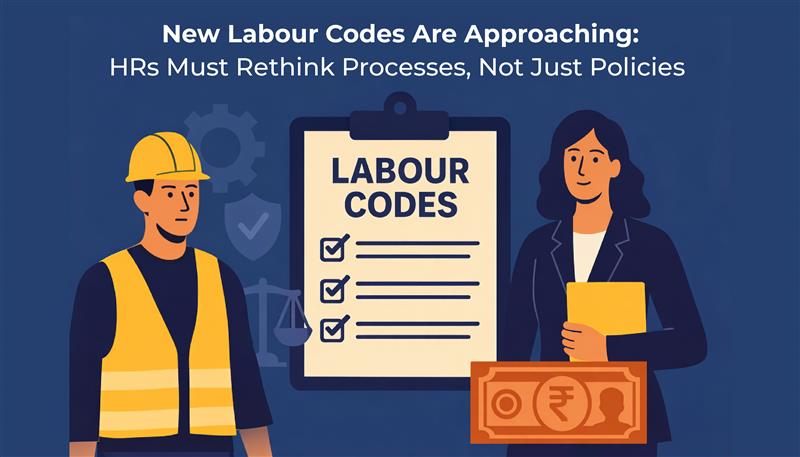
In November 2025, the Indian government consolidated 29 fragmented & outdated labour laws & merged them into 4 new labour codes. The upcoming implementation is not merely a legislative update— but a structural reset of how organisations design compensation, manage time, document employment, and ensure compliance across a diverse workforce. For HRs, the main challenge is to translate these codes into the daily operational discipline across industries, locations, and worker categories to adhere to the codes when implemented.
The complexity of this transition is focused on treating the codes of operation in inclusion. They are interdependent as the wages impact PF & gratuity, and the work hour policy affect attendance & payroll. Organisations must treat the new labour codes as a process transformation to adapt to the new labour codes smoothly.
In this blog, we will be focusing on industry-specific implications rather than the codes themselves, so that you can understand where your organisation needs to change to adhere to the new labour codes. But before starting, let’s have a quick glance at the codes to form the baseline.
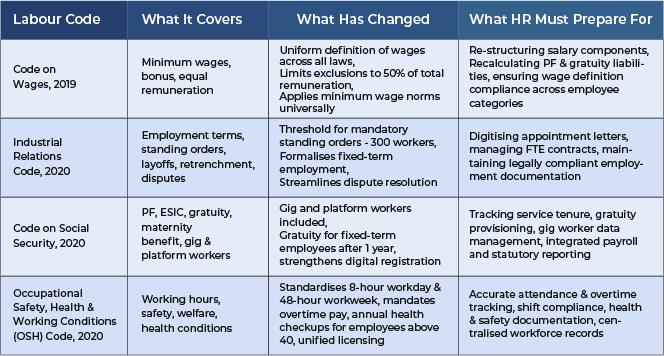
Let’s now look at the different changes that will impact the HR’s daily routine.
Wage Redefinition
Why Industry-Specific Salary Models Need Rework?
The uniform wage definition and the 50% exclusion cap will force HR teams to revisit long-standing salary structures—especially in industries where allowances dominate compensation.
In IT and IT-enabled services, it is common to see high components of special allowances, performance pay, and flexible benefits to maximise take-home pay. Under the new codes, if these exclusions exceed 50% of total remuneration, the excess is added back to wages for PF and gratuity calculation. For HR Heads, this means salary models that once looked tax-efficient may now increase statutory costs and alter employee net pay, requiring careful communication and restructuring.
In manufacturing and engineering organisations, the impact is often deeper at the shopfloor level. Multiple wage components—basic, DA, skill allowance, shift allowance, and attendance-linked incentives—must now be mapped correctly to the new wage definition. Any inconsistency between what is paid and what is reported can create compliance exposure during inspections.
This is where digital platforms like Tempus Central become critical. Instead of static salary templates, HR teams can model multiple wage structures, test statutory impact in real time, and ensure compliance across permanent employees and contract workers—without manual recalculations.
Working Hours & Attendance
Different Industries, Same Compliance Risk
The promise of flexible work arrangements under the labour codes is often misunderstood. While weekly hours are capped at 48, daily limits of 8 hours remain central (apart from a few states capped at 12 hours like Gujarat), with overtime payable at double wages and capped quarterly.
In manufacturing plants, extended shifts during peak production cycles are common. HR teams often discover compliance risks only after overtime limits are breached—by which point the violation has already occurred. Manual attendance systems or loosely controlled punch data make this worse.
In hospitality and healthcare, where operations run 24/7, shift overlaps, split shifts, and emergency coverage are part of daily life. Without system-enforced controls, employees may unintentionally exceed daily limits, exposing the organisation to overtime and wage disputes.
Even in IT and corporate offices, where flexible hours are popular, actual working hours are rarely tracked accurately. When attendance data is inconsistent, compliance becomes assumed rather than proven.
A digital attendance and workforce management system ensures that daily and weekly limits are enforced by design. HR teams can use the cloud based attendance system to align shift rosters, attendance capture, and payroll logic—turning compliance from a reactive audit activity into a proactive control mechanism.
Appointment Letters
From Paper Formality to Universal Legal Proof
The requirement to issue appointment letters to all categories of workers, including daily wage earners and fixed-term staff, has significant implications across labour-intensive industries.
In logistics, warehousing, and contractor-heavy environments, worker onboarding often happens at scale and speed. Documentation gaps—missing appointment letters, incomplete worker details, or outdated formats—are common and will no longer be defensible once the codes take effect.
Similarly, in hospitality and retail, high attrition and seasonal hiring mean appointment letters are often treated as administrative paperwork rather than legal records. The new codes elevate their importance by mandating specific identifiers such as Aadhaar, LIN, and UAN/ESIC details.
HR Heads now face the task of auditing existing records and issuing updated letters within strict timelines. Digital document generation and storage is no longer optional. Platforms like Tempus Central allow HR teams to standardise appointment letters, automate issuance during onboarding, and maintain an inspection-ready document repository across locations.
Gratuity
Fixed-Term Employees Change the Cost Equation
One of the most significant but often overlooked changes is the inclusion of fixed-term employees for gratuity eligibility after just one year of service.
In project-based industries such as EPC, infrastructure, and IT services, fixed-term hiring is a strategic workforce model. HR teams must now provision gratuity for employees who may have previously exited without such liability. Without accurate service tracking, organisations risk under-provisioning or disputes during exits.
In manufacturing, where fixed-term employment is used to manage demand cycles, gratuity calculations must now be precise and transparent—especially when multiple renewals or role changes occur.
A digital HR platform ensures tenure tracking, automatic eligibility identification, and accurate gratuity computation, protecting both the organisation and the employee from ambiguity.
One Nation, One Registration
Compliance Timelines Become Non-Negotiable
The shift towards a unified registration and return framework is designed to simplify compliance—but only for organisations that operate on integrated systems.
This is particularly critical for multi-location enterprises, where HR, payroll, and compliance data often sit in silos. When an employee exits, the requirement to complete Full & Final settlement within two working days leaves no room for manual coordination between departments.
Industries with high attrition—such as BPOs, retail, and hospitality—will feel this pressure most acutely. Delays caused by missing attendance data, unprocessed leave balances, or disconnected payroll systems will directly translate into non-compliance.
Integrated digital platforms like Tempus Central connect attendance, leave, payroll, and statutory calculations into a single workflow—making time-bound compliance achievable rather than aspirational.
Gig and Platform Workers
New Recognition, New Responsibility
For organisations engaging gig or platform workers—whether in delivery, mobility, or last-mile services—the labour codes introduce formal recognition and social security obligations.
HR and operations teams must now track payouts, worker engagement duration, and contribution calculations accurately. Informal records or third-party spreadsheets will not withstand regulatory scrutiny.
A digital platform helps organisations maintain worker classification clarity, contribution calculations, and reporting readiness—without disrupting flexible engagement models.
Health & Safety
Compliance Moves Into Workforce Wellbeing
Mandatory annual health checkups for employees above 40 bring health compliance into mainstream HR operations.
In manufacturing and heavy engineering, this aligns naturally with existing safety frameworks. However, in IT, services, and corporate offices, health compliance has traditionally been informal. HR teams must now track age eligibility, schedule checkups, and maintain proof of compliance.
Digitally maintained employee profiles and compliance trackers simplify this requirement and ensure no eligible employee is overlooked.
Conclusion: The Strategic Takeaway for HR Heads
Across industries, the message of the new labour codes is consistent: compliance will be continuous, data-driven, and system-enforced. HR Heads who rely on fragmented tools and manual interventions will face increasing operational risk—not due to intent, but due to structural limitations.
Moving to a digital HR & compliance platform like Tempus Central is no longer about automation alone. It is about enabling HR to operate with confidence in a regulatory environment where accuracy, timeliness, and traceability define compliance.
As the labour codes approach implementation, the question is no longer whether change is required—but how prepared your HR processes are to absorb it. Become the future-ready organisation by acting now, not when enforcement begins.